

How to Apply for a Swiss B Permit for EU and Non-EU employees
A practical guide for employers and HR teams navigating EU and third-country work permits

Fenja Brockmann
The Swiss B permit is a residence permit for people who plan to live in Switzerland for more than 1 year. Many employers use this permit when hiring international staff who need work authorisation. This guide explains the rules for EU/EFTA nationals and for non-EU/EFTA nationals.
Overview of the B Permit
The B permit is a renewable residence permit. Depending on nationality and the legal basis, the permit can be issued for one to five years.
Most B permits include work authorisation. However, some categories, for example, retirees, receive a B permit without the right to work. In such cases, it will be written on the residence card. VZAE/OASA and SEM implementation guidelines.
For non-EU/EFTA nationals, a B permit can be tied to a specific employer under Articles 18–23 AIG/FNIA. If the person resigns or is dismissed, the permit can be lost, and a new employer would need to complete a full work-permit application under the same legal framework.
Every B permit is linked to a specific Swiss canton. This is based on the structure of the AIG/FNIA and cantonal competence rules. When a person moves to another canton, they must notify the new canton and, depending on the situation, apply for authorisation to transfer the permit.
Key Features
Valid for one year or longer (AIG/FNIA; VZAE/OASA)
Usually renewable (AIG/FNIA; SEM Guidelines)
Often includes work authorisation
May be employer-tied for non-EU/EFTA workers (AIG/FNIA Art. 18–23)
Always linked to a specific canton (AIG/FNIA; cantonal procedures)
EU/EFTA rights based on the Agreement on the Free Movement of Persons (FZA/AFMP)
B Permit for EU and EFTA Nationals
EU and EFTA nationals benefit from the Agreement on the Free Movement of Persons. This makes the process simpler for employers.
1. Eligibility
Employees from EU and EFTA states may receive a B permit if they have
• an employment contract longer than 12 months or
• an unlimited employment contract.
2. Required documents for HR teams
Typical documents include
• Copy of passport
• Employment contract
• Proof of address in Switzerland
• Health insurance confirmation after arrival
Some cantons request additional documents.
3. Application process
Employee arrives in Switzerland.
Employee registers with the local commune within fourteen days of arrival.
The commune forwards the file to the cantonal migration office.
The canton issues the B permit card.
4. Timeline
For EU/EFTA citizens, employment may start after registration with the local commune and submission of the EU/EFTA residence application (required within 14 days of arrival).
The biometric B-permit card is then issued by the canton and typically arrives in a few weeks (about 3-8 weeks, depending on the canton and season). Timelines are based on our experience; authorities publish no fixed SLA.
5. Cost
The cost of an EU/EFTA B permit depends on the canton. As an example, in 2025 the fee in the canton of Zurich is 210 CHF. (Based on the Zurich Fee Ordinance.)
B Permit for Non-EU and Non-EFTA Nationals
The process is more restricted and requires employer involvement before the employee enters Switzerland.
Before issuing a B or L residence permit, every third-country national needs to get a work permit. A work permit is not the same as a residence permit.
1. Eligibility
Swiss immigration is built to give priority to local and EU/UEFTA citizens; therefore, only highly skilled or uniquely skilled professionals can be admitted. (FNIA / AIG / LEI, SR 142.20)
How authorities check if a candidate is qualified for a Work Permit:
Qualifications - certain jobs do not require rare skills can be filled by locals or EU/UEFTA citizens (for example, accountants, customer services, etc.)
Labour market test - proof that no local candidate was found
Justification Letter - a document describing why this candidate is a going to benefit Swiss economy and the company.
You can use this free assessment tool to estimate the chance of approval and timeline for your candidates by uploading the job description and CV/LinkedIn URL of the candidate.
Even if you got an approval for a work permit, it does not mean you will get a permit B. Authorities might decide to give a permit L (normally, limited to 1 year).
2. Required documents
HR teams typically collect and prepare:
Professional CV
Diplomas and certificates, and translations, apostilles if needed
Employment contract
Company and role description
Evidence of recruitment efforts
Office contract
Business plan (for startups and smaller companies)
Passport copy of the candidate
Justification letter
Cantons may request additional information.
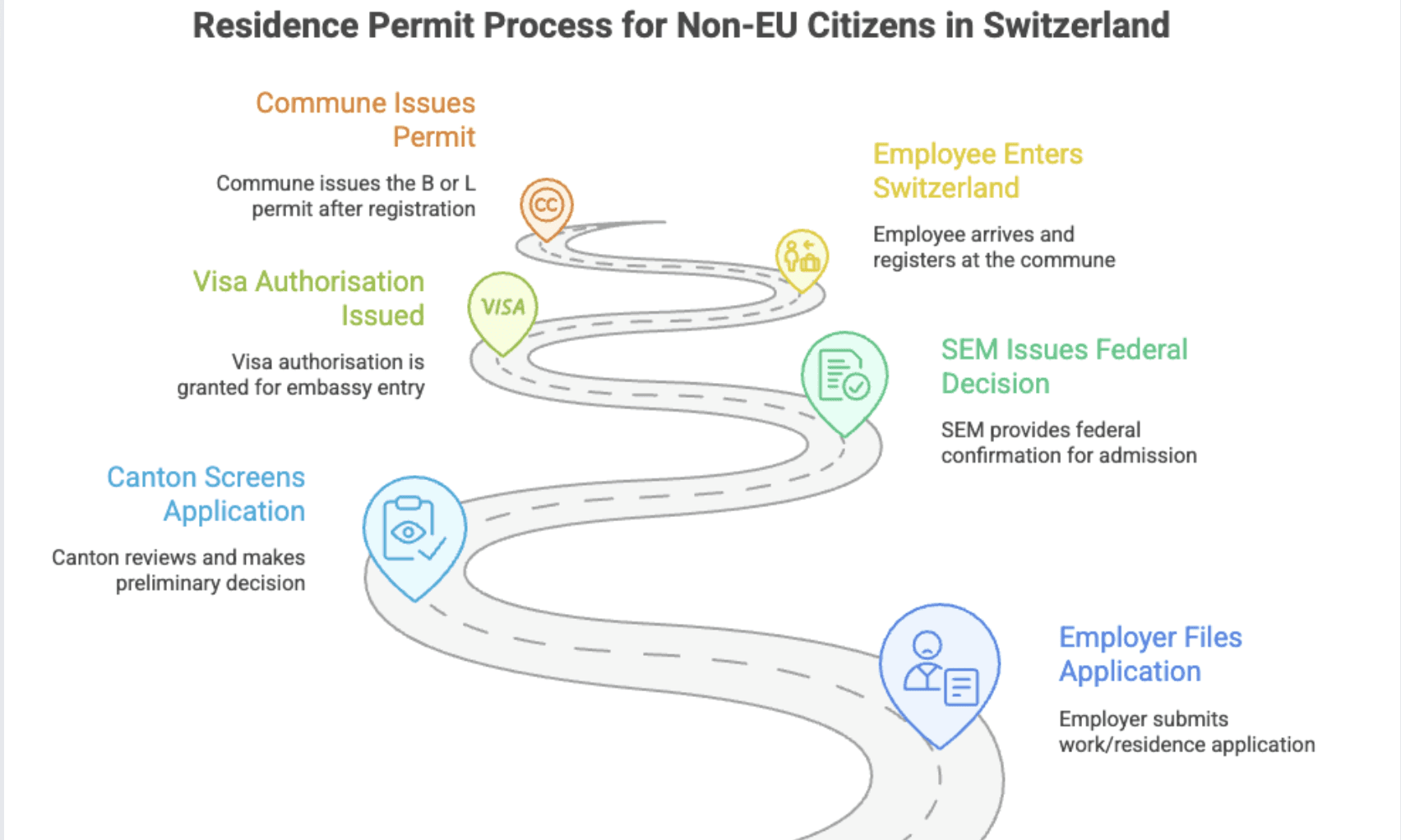
3. Application process
1. Employer files a complete work/residence application with the cantonal labour market or migration authority (Legal bases: FNIA (AIG) arts. 18–23)
Canton screens and issues a preliminary decision; if positive, it forwards to SEM for federal confirmation.
SEM issues the federal decision (Zusicherung) to admit for work/residence. This decision alone does not permit entry yet.
Visa authorisation is issued for embassy entry.
Employee enters Switzerland and registers at the commune.
The commune issues the B (or L) permit after residence registration.
4. Timeline
For third-country nationals, the processing times vary by canton and workload. From our experience, the timeline from applying until SEM approval is 3-12 weeks.
The biometric B-permit card is then issued by the canton and typically arrives in a few weeks (about 3-8 weeks, depending on the canton and season).
*Timelines are based on our experience; authorities publish no fixed SLA.
5. Cost
The governmental fee for a B permit for third-country nationals depends on the canton. For example, in 2025, the fee in the canton of Zurich is 400 CHF (fees are defined in cantonal regulations, such as the Zurich Fee Ordinance Gebührenordnung für die Verwaltungsbehörden, LS 682).
Because applications for non-EU/EFTA nationals are more complex, support services also cost more. Depending on the provider, assistance for handling a full work-permit process typically ranges from CHF 3,000–5,000 for a fixed package, or around CHF 250 per hour when billed by an immigration lawyer.
Duration and Renewal
5.1 EU and EFTA nationals
The B permit is usually valid for five years. Renewal is possible if employment continues.
5.2 Non-EU and Non-EFTA nationals
The B permit often has a one-year or five-year validity and can be renewed.
Practical Advice for HR and Founders
Start the application early especially for non EU staff.
Make sure the employment contract is matching Swiss standards
Take seriously compliance with salary benchmarks
Use clear job descriptions that match the employee’s skills
Keep copies of all recruitment evidence (including screenshots of job posting)
Confirm canton requirements because each canton can request different documents.